This question was asked during last Sunday’s service (10/25). Please join us this Sunday (11/1) as we continue our series in 2 Peter called Life in the Last Days.
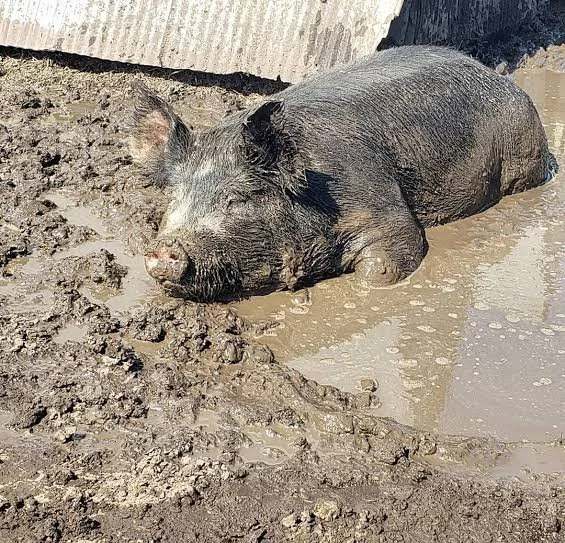
Pastor Joel, I have a question about your interpretation of the pig and the dog in 2 Peter 2:22, particularly as it relates to our identity in Christ.
When Peter describes a washed pig returning to the mud and a dog returning to its vomit, I wonder if we’re missing something important about the illustration. A pig returning to the mud is doing exactly what a pig does. And a dog returning to its vomit is behaving according to its nature.
So perhaps the lesson isn’t simply, “Pig, stop wallowing in the mud,” or “Dog, stop returning to your vomit.” Perhaps the deeper lesson is that washing a pig doesn’t change its nature. It is still a pig.
And that brings me to my question about Christian identity. Scripture tells us that when we are born again, we become new creations in Christ. The old has passed away, and the new has come (2 Corinthians 5:17). We haven’t simply been washed on the outside. We’ve been transformed on the inside. We are no longer who we once were. So when we encourage Christians to stop behaving like pigs or dogs, aren’t we in danger of reinforcing the very identity that Christ has already delivered them from?
Rather than telling a child of God, “Stop acting like a pig,” wouldn’t it be more faithful to the gospel to say:
“You’re not a pig anymore. You’re a child of God. You’ve been made new. Open your eyes to the beautiful reality of who you already are in Christ. Why would you want to return to something that no longer defines you?”
I believe genuine holiness flows out of understanding our new identity, rather than trying to earn that identity through improved behavior.
So here’s my question: Are we teaching Christians to behave their way into a new identity, or are we teaching them to live out the new identity they’ve already received through Christ?
And how do you reconcile your interpretation of Peter’s illustration with Paul’s declaration that we are already new creations in Christ?
Great and very important question.
First off, I agree with what you highlight in the 2 Corinthians 5 passage. Yes, genuine holiness flows out of understanding our new identity, rather than trying to earn that identity through improved behavior. I also agree (in large part) that the plea to believers is to ‘become who you truly are’. To put that in 2 Peter 1 language: “you have escaped from the corruption that is in the world because of sinful desire—for this reason, make every effort to supplement your faith with virtue…”
That being said, 2 Peter 2:22 is trying to accomplish something different from this. The main difference is that this is about the effects of false teaching in the church. One effect is how it leads Christians to behave contrary to their true identity—to the degree that some of them have ‘turned away’. In order to understand what this means for us, we must recognize that we are dealing with slightly different issues than those you have stated:
The nature of apostasy
The role of behavior in testing faith
The nature of the ‘two paths’ of wisdom literature
The nature of apostasy
Most Christians believe that the Bible teaches that apostasy is possible. Some think that if a person apostasizes, they were never a true believer to begin with. However, the language in 2 Peter 1:9, 2:1, and 2:20-21 seems to say that these people who turned back from Jesus were indeed Christians—if not, how could they have previously been ‘cleansed from their former sins’ (1:9), been ‘bought’ by the ‘Master’ (2:1), or ‘escaped the defilements of the world’ (2:20)?
Hebrews 6:4–6 and 10:26-27 agree with this view:
[4] For it is impossible, in the case of those who have once been enlightened, who have tasted the heavenly gift, and have shared in the Holy Spirit, [5] and have tasted the goodness of the word of God and the powers of the age to come, [6] and then have fallen away, to restore them again to repentance, since they are crucifying once again the Son of God to their own harm and holding him up to contempt.
[26] For if we go on sinning deliberately after receiving the knowledge of the truth, there no longer remains a sacrifice for sins, [27] but a fearful expectation of judgment, and a fury of fire that will consume the adversaries.
All that to say, I think that apostasy is revealed in Scripture as a real possibility for those who are believers. How does that square with election and predestination? I don’t know. As far as I’m aware, the Bible doesn’t reconcile that apparent paradox. But the Bible also doesn’t reconcile the paradox of free will versus election (as we will look at in 2 Peter 3:8-9 this coming Sunday).
John Calvin, who is often characterized as someone who would be a big predestination guy seems to support the view that true believers can apostasize:
“The gospel is a medicine that purges us as a wholesome emetic, but there are many dogs who swallow again what they have brought up, to their own ruin. Likewise the gospel is a basin which cleanses us from all our dirt and stains, but there are many pigs who, immediately after they have washed, roll back again into the mud. Thus the godly are warned to beware of both dangers if they do not want to be included in the ranks of dogs and pigs.”**
My point in arguing for a biblical view of apostasy is that for someone who, in the sight of God is his child and not a ‘dog’ or a ‘pig,’ there remains open the possibility that they can behave their way into such a lifestyle that they have turned back from their identity as a new creation and forsaken the saving faith they once had.
The nature of behavior in testing faith
God tests the faith of those who have become Christians. That testing, we are warned in Scripture repeatedly, must be endured to the end (Matthew 10:22, 24:13; Luke 8:13; 2 Corinthians 13:5; Hebrews 3:14). When God tests us, it is a confirmation of what was genuinely there. A couple examples:
James 1:12 - Blessed is the man who remains steadfast under trial, for when he has stood the test he will receive the crown of life, which God has promised to those who love him.
1 Peter 1:7 - so that the tested genuineness of your faith—more precious than gold that perishes though it is tested by fire—may be found to result in praise and glory and honor at the revelation of Jesus Christ.
God does not test our faith in mere thoughts or feelings, but in how we live. Here’s how Robert Mounce explained it in his commentary on Romans 2:1-11:
Faith is not an abstract quality that can be validated by some spiritual test unrelated to life. God judges faith by the difference it makes in how a person actually lives. A man’s destiny on Judgment Day will depend not on whether he has known God’s will but on whether he has done it.***
The point is that we cannot assume that a person is a new creation in Christ if their life has shown a pattern of faithlessness. Someone who lives as though they have rejected Christ’s free gift of grace may, in fact, be the pig which has returned to its ‘pigness’.
This is not easy to accept. In response to this, our hearts naturally want to ask, “where is the line? How much do I have to do to prove my faith is genuine?” But the Bible never addresses that question. I think it’s because it’s the wrong question. This life is one where God’s grace will always meet us when we seek him, not one where we try and somehow do enough to make him have to save us. He wants us to depend on him wholeheartedly.
The nature of the ‘two paths’ of wisdom literature
As I said in the sermon, 2 Peter 2:22 (and much of chapter 2 as a whole) is wisdom literature. Wisdom literature often uses the ‘two paths’ metaphor. In the book of Proverbs (which Peter is quoting and expounding upon here), the two paths are the path to life (wisdom) and the path to death (folly). When we do wise things we are acting like the wise—we are on the path to life. When we do foolish things we are acting like fools—we are on the path to death. And we must face the many warnings in this passage and all throughout scripture that you cannot walk the path of death and have it lead to life. In other words, a true believer who apostatizes and never repents is headed for the logical conclusion of destruction.
Conclusion
How does all of this relate to the status of Christians as new creations in Christ? The complexity only increases when we consider that we will not be complete and perfect until we see him face to face. All of us will sin and fail. But there does seem to be a distinction in scripture between ‘falling away’ and merely sinning or failing. We can be confident we have not apostasized, not because we never sin, but if we have not forsaken Jesus
For those of us who receive the freely given grace of Jesus, our hope and motivation for godly living is not that we might control the outcome of our eternal destiny, but that, in casting ourselves completely on the mercy of God, he would be glorified in us.
Got more questions about this text or some other hard passage? Share it with me
In the Love of Christ,
Pastor Joel
** John Calvin, The Epistles of Peter, edited by D.W. and T.F. Torrance (Clavin’s Commentaries), 1963.
*** Robert Mounce, Romans, New American Commentary